
 Resumé
📣 Marketing & Branding 101
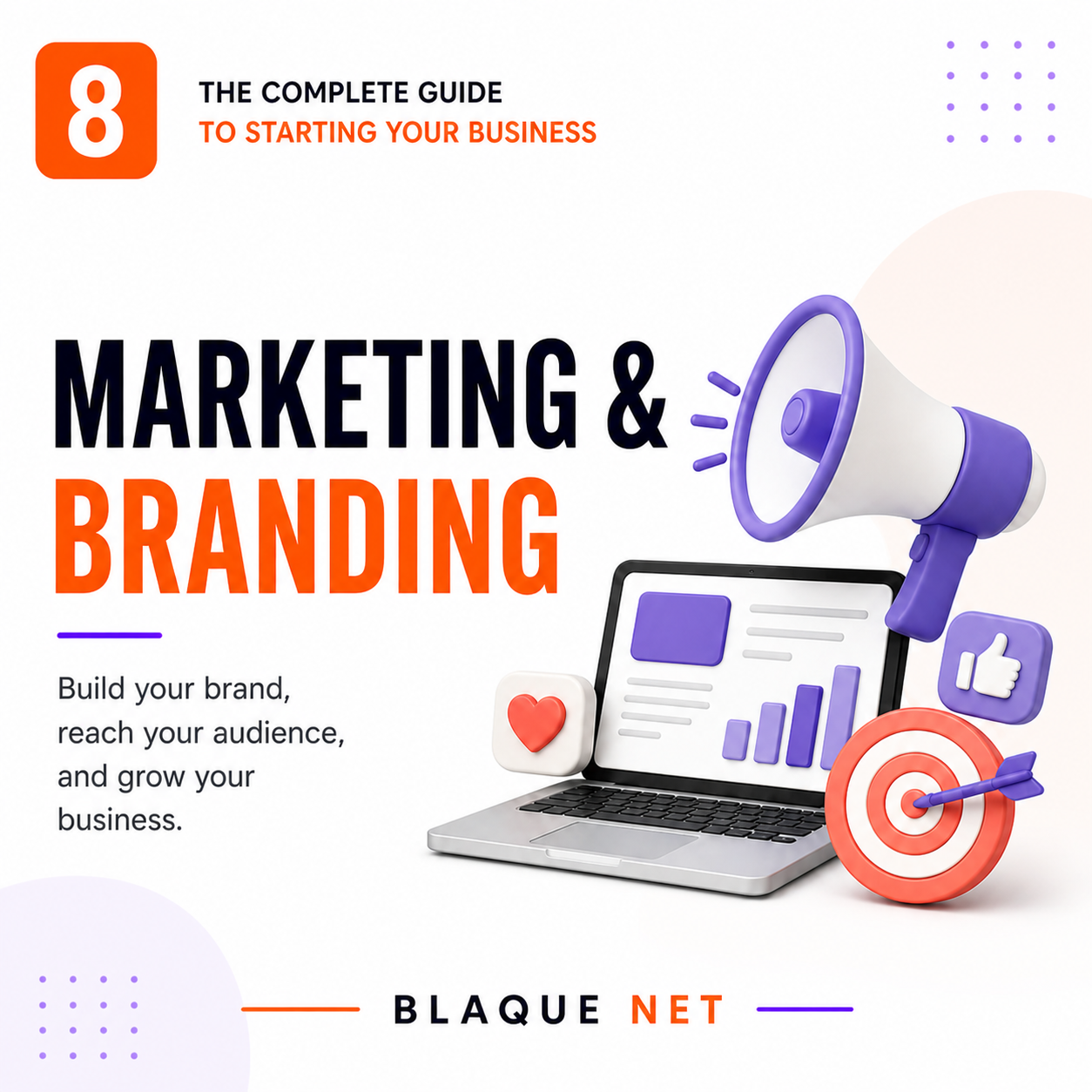
📣 Marketing & Branding 101
The best product in the world goes broke if nobody knows it exists. Here's how to build a brand and market it without wasting your budget.
Branding vs. Marketing — The Difference Matters
The analogy: Your brand is your personality. Marketing is how loud you speak. If your personality is unclear and inconsistent, speaking louder just creates more confusing noise. Get your brand foundation right first — then market.
Build Your Brand Foundation
The 5 Brand Building Blocks
- Mission Statement: Why does your business exist beyond making money? One sentence that captures your purpose. This guides every decision and attracts the right customers and team members.
- Core Values: What do you stand for? What lines will you not cross? 3–5 words or phrases that are genuinely yours — not generic ones that look good on a website.
- Brand Voice & Tone: How do you sound? Casual or formal? Bold or gentle? Playful or serious? Pick a lane and stay in it consistently across every channel — emails, social, website, packaging, everything.
- Visual Identity: Logo, color palette, typography, photo style. Consistent visuals build instant recognition. People should see your colors or style and immediately know it's you — before reading a single word.
- Your Story: Why you started this, what drove you here, what you've overcome. Customers connect with humans, not logos. The founder story is one of your most powerful marketing assets — use it.
This single sentence is the most important marketing asset you have. Every piece of marketing should point back to it.
Formula: "We help [WHO] do [WHAT] so they can [RESULT] — without [COMMON PAIN OR OBSTACLE]."
Example: "We help first-generation entrepreneurs get funding-ready in 30 days — without needing a finance degree or a $500 consultant."
Once you have this, it goes everywhere: website homepage headline, social media bio, pitch deck, email signature, when someone asks "what do you do?" at a networking event.
Know Your Audience — The Most Important Work You'll Do
Bad marketing tries to reach everyone. Good marketing speaks so directly to one specific person that they feel like you read their mind. Before you post anything, run any ad, or send any email — answer these questions in writing about your ideal customer:
- What does their day actually look like? What problems show up regularly?
- What language do they use to describe their own problem? (Use their words — not yours)
- What have they already tried that didn't work? Why?
- What outcome do they want more than anything?
- Where do they spend time online? What do they watch, read, follow?
- What would make them trust you enough to buy without hesitation?
- What objections would they raise, and how do you answer each one?
The Marketing Funnel — How Strangers Become Customers
Marketing is not random posting hoping something sticks. It's a system that moves people from strangers to paying customers. You need content and touchpoints at every stage — not just the top.
Most small businesses only create content at the Awareness stage (social posts, ads) and then wonder why nobody buys. You need content that serves people at every stage of their decision-making journey.
Choosing Your Marketing Channels — Go Deep Before You Go Wide
You do not need to be on every platform. You need to dominate 2–3 channels consistently before expanding. Scattered, half-hearted presence on 6 platforms beats no one. Deep, consistent presence on 2 platforms builds a business.
SEO Basics — Getting Found on Google Without Paying for Ads
SEO (Search Engine Optimization) is the process of making your website show up when potential customers search for what you offer. It's free traffic that compounds over time.
- 1Know what your customers search for — Use Google's free Keyword Planner or just type your service into Google and look at the autocomplete suggestions. Those are real searches.
- 2Create pages that answer those searches — A service page, a blog post, an FAQ — your content needs to exist to rank for the searches you want to appear in.
- 3Claim your Google Business Profile — Free. Takes 30 minutes. Enormous impact for local search. Optimize it with photos, hours, services, and regularly respond to reviews.
- 4Make sure your website loads fast on mobile — Over 60% of searches happen on phones. Google penalizes slow, non-mobile-friendly sites. Use Google PageSpeed Insights (free) to check.
- 5Build backlinks gradually — Get other websites to link to yours. Local chambers, SCORE, press mentions, guest articles, directories. Each quality link improves your authority in Google's eyes.
- 6Install Google Analytics and Search Console — Both free. Analytics shows you who visits your site and what they do. Search Console shows what searches they used to find you.
- 7Be consistent with new content — One new, helpful piece of content per week is enough to build authority over time. Focus on quality over quantity.
Email Marketing — Build This From Day One
Your email list is the single most valuable marketing asset you can own. Unlike social media followers, you own your email list outright. No algorithm change, no platform shutdown can take it away.
-
1Choose a platform — Mailchimp is free up to 500 contacts and plenty for starting out. ConvertKit is better for creators and course sellers. Klaviyo is best for e-commerce.
-
2Create a lead magnet — Give people a reason to subscribe. A free checklist, a guide, a discount, a free consultation, access to something valuable. "Subscribe to our newsletter" alone doesn't work anymore.
-
3Write a welcome sequence (3–5 emails) — When someone subscribes, they should automatically receive: a welcome + what to expect, your story and why you started, your most helpful resource, social proof (testimonials), and a soft invitation to buy or book a call.
-
4Send consistently — Weekly, biweekly, or monthly — pick a cadence you can sustain and do it. Inconsistent emails train your list to ignore you.
-
5Write like a human, not a newsletter — Short paragraphs. Conversational tone. One topic per email. One clear call to action. Plain text emails often outperform designed templates in open rates.
Content Marketing — The Long Game That Wins
Content marketing is creating helpful, valuable content that attracts your ideal customer before they're ready to buy — building trust and staying top of mind for when they are ready.
The 4 types of content that work:
- Educational: Teach your audience something useful. "How to [do the thing they want to do]" content builds trust and positions you as the expert.
- Inspirational: Stories — yours and your customers'. Success stories, lessons learned, what you'd do differently. People buy from people they believe in.
- Entertaining: Don't be boring. Your personality is a differentiator. Behind-the-scenes content, honest opinions, humor when appropriate.
- Promotional: This is where most businesses stop — they only post "buy my thing." Promotional content should be no more than 20% of your total output. Earn the right to pitch by delivering value first.
Pricing Strategy — The Marketing Move Nobody Talks About
Your price is a marketing signal. Too low communicates low quality and attracts clients who drain you. Too high without the right positioning loses customers you could have served. Price strategically.
- Cover your real costs: Time, overhead, software, marketing, taxes, and the value of your expertise. Underpricing to "get clients" is a race to the bottom you cannot win.
- Use anchor pricing (3 tiers): Offer Good / Better / Best options. Most people choose the middle. The high tier makes the middle feel reasonable and sometimes surprises you by selling.
- Value-based pricing: Charge based on what the outcome is worth to the client — not how long it takes you. A one-hour strategy call that saves a client $20,000 is worth far more than $150.
- Test price increases regularly: Raise prices 10–20% every 6–12 months as your experience and reputation grow. You will almost never lose as many clients as you fear, and the ones you do lose are replaced by better-fit ones.
- Never compete solely on price: There will always be someone willing to do it cheaper. Compete on quality, speed, results, experience, or relationship. Price-based competition erodes your business over time.
✅ Your Section 8 Checklist
Why does my business exist beyond making money? Every team member and customer should be able to repeat it.
Casual? Bold? Warm? Expert? Pick your lane and document it so every piece of content is consistent.
"We help [WHO] do [WHAT] so they can [RESULT] without [OBSTACLE]." Placed it on my homepage.
Demographics, psychographics, language they use, platforms they're on, objections they have.
Free. Takes 30 minutes. Critical for local search. Photos, hours, services, categories all filled in.
Added a signup form to my website. Created a lead magnet. Wrote my welcome email.
Committed to going deep on these before adding more. Calendar blocked for consistent posting.
Both free. Tracking traffic, sources, search queries, and user behavior from day one.
One that teaches, one that shares my story, one that presents my service or product.
Social proof closes sales. Ask while the experience is fresh — a week after delivery at most.
Business directory listing, networking circles, community access — all in one platform.
🎯 Quick-Scan Summary
- Brand = who you are. Marketing = how you show up. Get the brand foundation right first.
- Your USP is your most powerful marketing asset — one sentence that captures exactly who you help and how
- Know your customer deeply — demographics, psychology, exact language they use about their problem
- Pick 2–3 channels and go deep before spreading to more. Consistency beats volume every time.
- Email list is your most valuable, algorithm-proof asset — start building it on Day 1
- Claim your Google Business Profile — free, 30 minutes, enormous local search impact
- Create content at all 4 funnel stages — not just awareness posts. Build trust through every stage.
- Price based on value, not just cost. Raise prices regularly. Never compete solely on being cheapest.
Last Updated: April 2026 · Part 8 of 10 · Blaque Net Start Your Business Series

 Turkish
 English
 Arabic
 French
 Spanish
 Portuguese
 Deutsch
 Dutch
Dutch
 Italiano
 Russian
 Romaian
 Portuguese (Brazil)
 Greek
Greek