
 Resumé
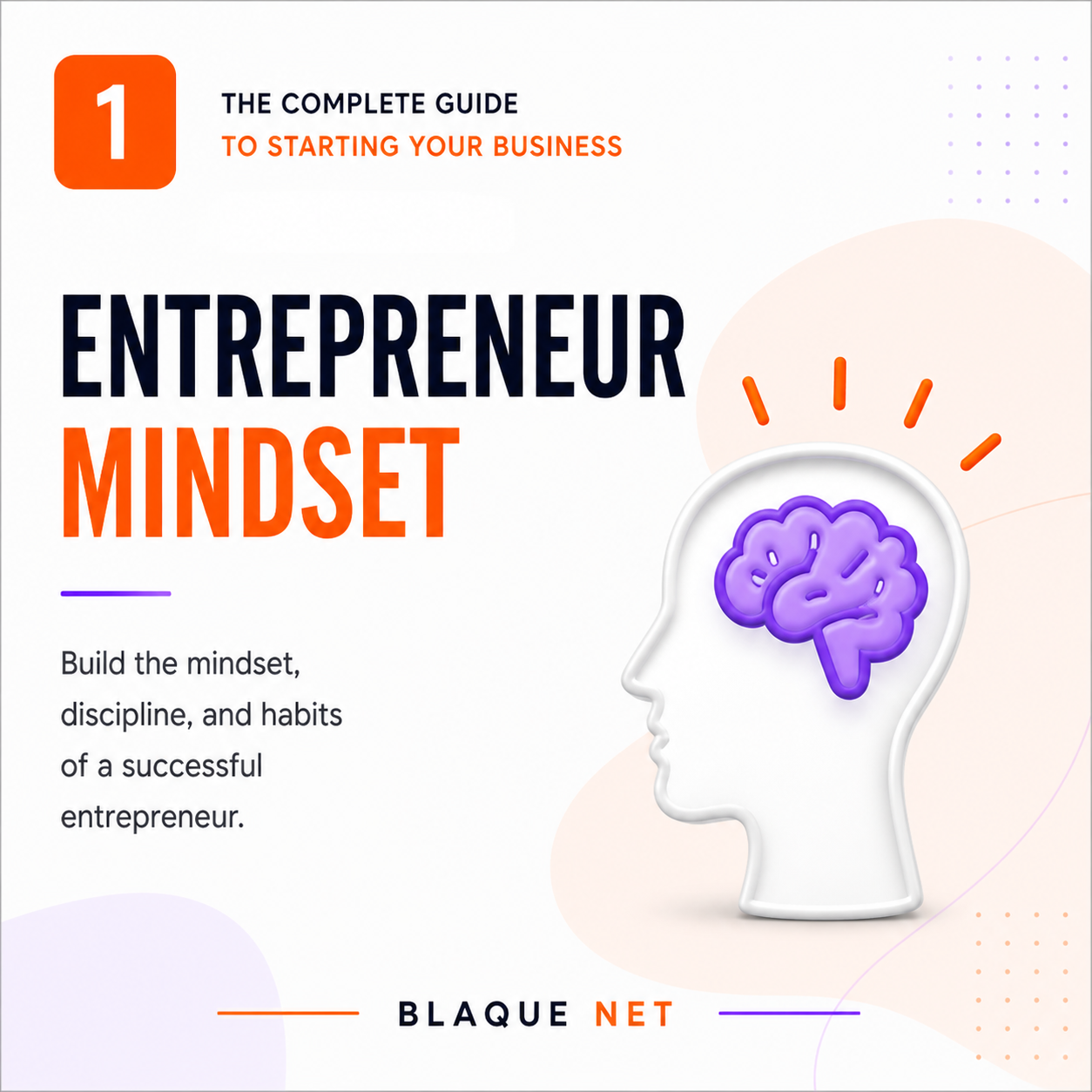
🧠 Are You Ready to Be an Entrepreneur?
🧠 Are You Ready to Be an Entrepreneur?
Honest answers, a scored readiness assessment, and the full side-hustle-to-full-time transition guide.
The Real Talk First
Entrepreneurship looks amazing on social media. Your own hours, your own boss, build wealth on your terms. All of that is real and possible. But it's also one of the hardest things you will ever do.
The #1 reason businesses fail isn't a bad idea. It's a founder who wasn't prepared for what building actually requires.
- Build something entirely yours
- Unlimited income ceiling
- Flexibility to design your schedule
- Tax advantages unavailable to employees
- Build generational wealth
- Inconsistent income — especially Year 1
- You wear every hat at the start
- No paid time off or employer benefits
- Requires self-discipline without external accountability
- Most businesses take 2–3 years to be truly profitable
Your Entrepreneur Readiness Assessment
Rate all 10 areas honestly. Add your scores and use the guide below to know exactly where to focus before you build.
📋 Rate each area 1–5
1 = Not at all · 3 = Somewhat · 5 = Absolutely
1. Financial resilience — I can handle income uncertainty for 6–12 months without serious panic or abandoning the plan.
2. Self-motivation — I don't need a boss or external accountability to take action consistently.
3. Resilience — I handle rejection, criticism, and setbacks without shutting down or giving up.
4. Learner's mindset — I am willing to learn the skills I don't have yet: sales, finance, marketing, operations.
5. Support system — I have at least one person in my life who genuinely supports this decision.
6. Problem clarity — I can describe in one sentence the problem I'm solving and exactly who has it.
7. Financial runway — I have 3–6 months of living expenses saved, or a clear bridge income plan.
8. Decision-making comfort — I can make important decisions without having every piece of information.
9. Emotional separation — A bad month or failure won't break my identity or make me quit entirely.
10. Work ethic — I am willing to outwork what I've ever done before for at least the first 1–2 years.
📊 How to Read Your Score (out of 50)
Strong foundations across nearly every readiness dimension. Address remaining gaps with intention as you build. The biggest risk at your level is overthinking rather than doing.
Real strengths and meaningful gaps to close. Pick your 2 lowest areas and spend 30 days closing them before making major financial commitments.
Not the moment to quit your job and go all-in — and that self-awareness is a major asset. Spend 60–90 days building your financial runway and finding one mentor.
Every category is showing gaps — that's your map. Connect with a free SCORE mentor this week and build a 90-day foundation plan before spending any money.
The 5 Things You Need Before Day One
What Type of Entrepreneur Are You?
Skills-based service. Lowest startup cost, fastest first dollar.
Challenge: Income stops when you stop working.
Shopify store, courses, templates, apps.
Challenge: Margins, inventory, standing out.
Agency, professional services, contractor model.
Challenge: Consistent client pipeline.
SaaS platform, tech marketplace, consumer app.
Challenge: Funding, product-market fit, long runway.
🚀 The Side Hustle → Full-Time Transition
Most successful entrepreneurs don't quit their job on a Monday and build a company by Friday. The majority started on the side — nights, weekends, early mornings — and made the leap when the numbers justified it. This section is for founders building while still employed: when is it actually time to go full-time?
Starting Part-Time Is a Strategy, Not a Compromise
Building on the side while employed gives you something most full-time founders don't have: a financial floor. You can take more time to validate, make cheaper mistakes, and choose clients more selectively because you're not desperate. Founders who leap too early often take the wrong clients, charge too little, and burn out before they find traction.
The goal of the side-hustle phase is not to build the whole business. The goal is to prove the model works before your income depends on it.
The 5 Financial Triggers That Mean You're Ready
Don't make this decision based on excitement or burnout. Make it based on numbers. You're ready when at least 3 of these 5 are true:
Before You Give Notice — Non-Negotiables
Your First 90 Days Full-Time
- Structure disappears overnight. Your job imposed a schedule. Now you create one. Block your work hours on Day 1 and treat them as non-negotiable. Founders who don't do this immediately often spend their first month feeling busy but moving slowly.
- Your one goal for 90 days: replace your salary. Not launch a new product. Not redesign your website. Not build your social media presence. Replace your salary first. Everything else is secondary until that number is hit.
- Build external accountability in immediately. No team, no colleagues, no validation. A mastermind, a Blaque Net Business Circle, or a weekly mentor check-in prevents the isolation that quietly kills momentum.
- Set a financial review at 60 days. Are you on track to cover personal expenses from business income? If not — what one thing needs to change? Don't wait until month 6 to have this conversation with yourself.
When you were employed, your job was to do good work. When you go full-time on your business, your job is to find and keep customers. Everything else serves that mission. Founders who treat the business like a job — show up, do the work, wait to be paid — stay stuck. Founders who treat it like a sales-and-delivery operation move faster.
✅ Your Section 1 Checklist
🎯 Quick-Scan Summary
- Entrepreneurship is rewarding and genuinely hard — go in with eyes open
- You need 5 things before Day One: financial runway, protected time, learner mindset, support system, problem clarity
- Take the scored assessment — your gaps are your first work to do
- Know your entrepreneur type — it shapes your entire first-year strategy
- Perfection paralysis kills more businesses than bad ideas. Start messy. Refine in motion.
- The leap to full-time should be triggered by numbers, not emotion — 3 of 5 financial signals, not just excitement or burnout
Last Updated: April 2026 · Blaque Net Start Your Business Series
Start Building with the Right Tools. 🤖
Business Buddy AI, Capital OS, and a full resource library are waiting inside Blaque Net.
Open Business Buddy →Entrepreneur Readiness — FAQ
How do I know if I'm ready to start a business?
You're ready when you have a validated idea, a clear target market, and willingness to act despite uncertainty. Readiness isn't about having everything figured out — it's about enough clarity to take the next step. Use the scored readiness assessment in this guide to get your honest answer.
How do I transition from side hustle to full-time?
The transition works best when your side hustle generates 50–75% of your salary for 3+ consecutive months, you have 3–6 months of personal expenses saved, and you have at least 3 paying repeat customers. Don't quit to start — quit because the business already works.
What mindset do successful entrepreneurs share?
Comfort with uncertainty, consistent action without external validation, willingness to sell your own work, ability to use feedback without taking it personally, and long-term thinking. Skills can be learned — mindset determines whether you keep going when it gets hard.
What is the biggest mistake first-time entrepreneurs make?
Building before validating. Most first-time entrepreneurs spend months building a product before confirming anyone will pay for it. Validate your price and customer first — sell the idea before you build anything.
How does Capital OS help early-stage entrepreneurs with funding?
Capital OS is the AI Funding Intelligence platform on Blaque Net. It measures your Capital Readiness Score and surfaces grants, loans, and programs matched to your stage — even pre-revenue. It tells you exactly what to build toward to qualify for funding. Free plan at blaquenet.com.

 English
 Arabic
 French
 Spanish
 Portuguese
 Deutsch
 Turkish
 Dutch
Dutch
 Italiano
 Russian
 Romaian
 Portuguese (Brazil)
 Greek
Greek