
- Новости
- ИССЛЕДОВАТЬ
- Businesses
- Reels
- Resources
- Blaque Market
- Offers
-
 Resumé
📣 Marketing & Branding 101
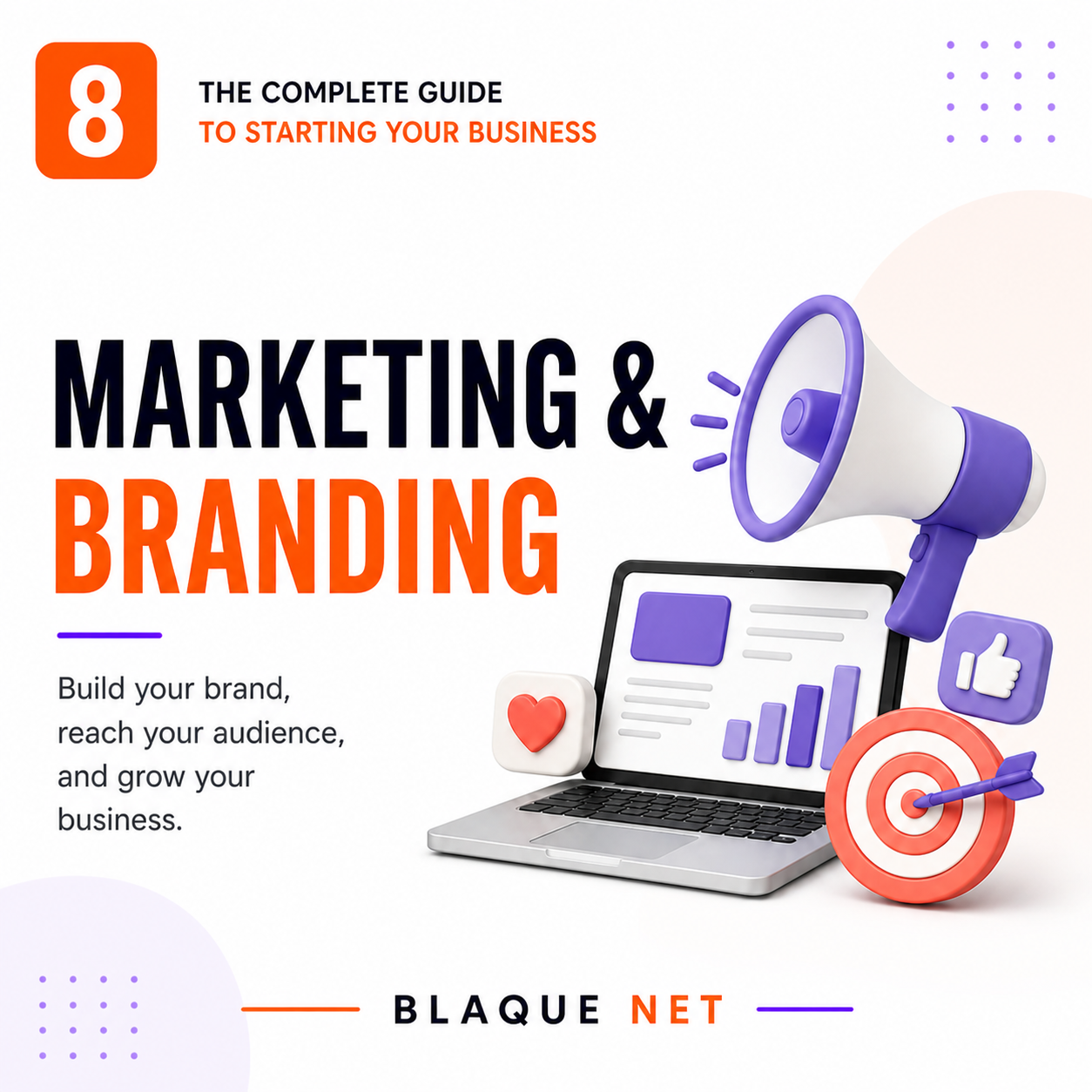
🔥 Marketing & Branding 101
The best product in the world goes nowhere without a brand people trust and a marketing system that reaches them consistently. Build the brand, then amplify it.
Brand vs. Marketing — What's the Difference and Why It Matters
These two words get used interchangeably and they shouldn't. Confusing them leads to businesses that spend money on marketing before they have a brand — and then wonder why nothing sticks.
Your brand is what people feel and believe about your business when they encounter it. It's the sum of your visual identity, your voice, your values, your reputation, and the experience you deliver.
Brand is built over time through consistent action. You don't create a brand with a logo — you build it with every interaction, every delivery, and every promise you keep or break.
Marketing is the deliberate effort to bring your brand and offer to the attention of the right people at the right time. It's the channels, messages, campaigns, and systems that drive awareness, interest, and action.
Marketing amplifies what already exists. If your brand is unclear, marketing amplifies the confusion. Build the brand first. Then pour fuel on it.
🌟 Your Brand Foundation — The 6 Elements That Define Everything
🤖 Capital OS Captures Your Brand Voice — So Everything Sounds Like You
One of the most powerful and overlooked features of Capital OS is the Founder Voice & Brand Identity intake. Before Capital OS writes anything for you, it learns who you are — your tone, your story, your values, the way you communicate.
That means every piece of content it generates is written in your voice, reflecting your brand identity. Not generic AI output. Your words. Your tone. Your brand.
Consistency is what turns a brand into a reputation. Capital OS makes sure your voice stays consistent across every channel and every communication — even on the days you don't have time to write.
🌐 Your Digital Presence — The Foundation Before the Campaigns
Before you spend a dollar on ads or content, your digital foundation must be solid. Every marketing channel ultimately sends people somewhere — that somewhere needs to convert visitors into believers and believers into buyers.
💻 Your Website — The Asset You Own
Social media platforms can change algorithms, ban accounts, or disappear. Your website is the only digital real estate you fully own and control. Every marketing effort should ultimately drive people here.
- Clear headline: what you do + who it's for
- One primary call-to-action above the fold
- Social proof (testimonials, case studies, logos)
- Services/products page with clear pricing or CTA
- About page that builds personal credibility
- Contact page with multiple contact methods
- Privacy Policy and Terms of Service
- Mobile-optimized, fast-loading (under 3 seconds)
- Squarespace / Wix — Design-first, quick setup, best for service businesses and portfolios
- WordPress — Most flexible, best for SEO, requires more setup, ideal for content-heavy sites
- Shopify — E-commerce first, best for product businesses
- Webflow — Designer-grade, no-code, powerful for premium builds
- Custom domain (yourname.com, not yourname.wix.com)
- Page titles and meta descriptions for every page
- Google Business Profile set up and verified
- Site submitted to Google Search Console
- Fast load time (test with Google PageSpeed)
- SSL certificate (https:// not http://)
- Local SEO: address, phone, hours, and category correct everywhere
📧 Email List — The Most Valuable Marketing Asset You'll Ever Build
Social media reach is rented. Email reach is owned. An engaged email list consistently outperforms every social media channel for conversion, revenue per subscriber, and long-term relationship building. Start building it on day one — even with zero subscribers.
- Mailchimp — Free to 500 contacts. Easy to use. Good starter option.
- ConvertKit (Kit) — Best for creators and content businesses. Strong automation.
- Klaviyo — Best for e-commerce. Revenue-focused analytics.
- ActiveCampaign — Best automation & CRM combo for service businesses.
- Beehiiv — Built for newsletters. Growing fast. Clean UX.
- Lead magnet: free checklist, template, guide, or tool in exchange for email
- Opt-in forms on every page of your website
- Link in bio on every social profile
- Promote your list at every in-person event
- Every client and inquiry becomes a subscriber (with consent)
- Welcome sequence: 3–5 emails that introduce your brand, story, and offer
- Weekly or bi-weekly value email: tip, resource, insight, or story
- Promotional emails: new offers, launches, limited availability
- Re-engagement campaigns for inactive subscribers
- Rule of thumb: 3–4 value emails for every 1 promotional email
📍 Google Business Profile — Free and Non-Negotiable for Local Businesses
A verified Google Business Profile puts your business on Google Maps, in local search results, and in the knowledge panel that appears when someone searches your business name. It's free, takes 30 minutes to set up, and directly impacts how many people find you.
- Complete every field: business name, category, address, phone, website, hours, description, attributes.
- Add photos: exterior, interior, team, products. Profiles with photos get 42% more direction requests.
- Collect and respond to reviews: Ask every satisfied customer. Respond to every review — positive and negative. This directly impacts local search ranking.
- Post weekly updates: Google Posts appear in your listing and signal active engagement to the algorithm.
- Verify immediately: An unverified profile can be edited by anyone. Verify via postcard, phone, or video depending on your business type.
📷 Social Media Strategy — Choose Your Channels Deliberately
The biggest mistake entrepreneurs make with social media is trying to be everywhere. You don't need to be on every platform — you need to dominate the one or two where your customers actually spend time. Spread thin and inconsistent beats focused and consistent every time.
| Platform | Primary Audience | Best Content | Best For | Posting Frequency |
|---|---|---|---|---|
| Blaque Net ⭐ | Entrepreneurs, founders, business owners — all industries | Business profiles, marketplace listings, circle posts, events | Brand visibility, B2B networking, direct sales, community | Daily activity recommended |
| 18–44, visual consumers | Reels, Stories, carousels | Brand awareness, lifestyle, B2C | 4–7x/week | |
| Professionals, decision-makers | Thought leadership, case studies, text posts | B2B, professional services, recruiting | 3–5x/week | |
| TikTok | 18–35, discovery-driven | Short-form video, education, entertainment | Brand awareness, viral reach, B2C | 1–3x/day |
| 35–65, community-oriented | Groups, events, ads, video | Local business, community, paid ads | 3–5x/week | |
| YouTube | All ages, intent-driven search | Long-form tutorials, reviews, deep dives | SEO, authority building, long-term traffic | 1–2x/week |
| X (Twitter) | Tech, media, finance, news | Short takes, threads, real-time commentary | Thought leadership, niche communities | 3–10x/day |
📝 Content Pillars — The System Behind Consistent Content
Content pillars are 3–5 core topics your brand consistently creates content around. They keep your content focused, make planning faster, and build expertise in a specific area over time rather than creating random one-off posts.
💵 Pricing Strategy — The Marketing Decision Nobody Talks About
Pricing is not just a financial decision — it's one of the most powerful signals your brand sends. Your price communicates your positioning, attracts or repels specific customer types, and directly shapes the perceived value of everything you offer. Get it wrong and your marketing has to work twice as hard.
The 3 Numbers You Need Before You Price Anything
Pricing Models — Choose the Right Structure for Your Business
Pricing Rules That Protect Your Business
- Never compete on being the cheapest. There will always be someone willing to undercut you. Competing on price is a race to the bottom you can't win long-term. Compete on expertise, speed, reliability, and relationships.
- Your first price is almost certainly too low. Most new founders underprice by 30–50% out of fear of rejection. Quote your real price, then be silent. Silence after a price is consideration, not rejection.
- Raise your prices every 6–12 months. As your experience, results, and reputation grow, your price should too. A 15–20% annual increase is reasonable and expected. Clients who leave over a modest increase were never your best clients.
- Discount strategically, never out of desperation. Discounts given to close a deal train clients to always wait for a discount. If you offer one, attach it to something: a faster decision, a longer commitment, an expanded scope.
- Test your price before you commit to it. During early sales conversations, name your price and watch the reaction. Immediate yes without hesitation? Price is too low. Immediate no without discussion? Either price is too high or value isn't clear yet.
🔍 Paid Advertising — When to Start and How to Not Burn the Budget
Paid ads are an accelerator, not a foundation. Running ads before you have a proven offer, a converting landing page, and a clear customer definition is the fastest way to waste money. When the conditions are right, paid advertising is one of the most powerful growth levers available.
Show up when someone searches for your exact service. Intent-driven — the person is already looking for what you offer. High conversion when targeted correctly.
Best for: Service businesses, local businesses, any business with clear search intent. Minimum budget to test: $500–$1,000/month.
Interrupt-based advertising. Reach people by demographics, interests, and behaviors before they're actively searching. Best for brand awareness, lead generation, and retargeting.
Best for: B2C products, local businesses, courses, events. Minimum budget to test: $300–$500/month.
The most precise B2B targeting available. Reach by job title, company size, industry, and seniority. Expensive per click but extremely qualified leads for the right offer.
Best for: B2B services, consulting, SaaS, recruiting. Minimum budget to test: $1,000+/month.
Pay per lead (not per click) for local service businesses. Appear at the very top of Google search results with a "Google Guaranteed" badge. Extremely effective for home services, legal, medical, and financial professionals.
Best for: Any licensed local service business. Cost: $15–$150 per lead depending on industry.
- You have a specific offer with a clear price
- You have a dedicated landing page (not your homepage) with one CTA
- You know exactly who you're targeting (demographics, location, interests)
- You have tracking set up (Meta Pixel, Google Tag) to measure results
- You know your target cost per lead or cost per acquisition
📈 Marketing Metrics That Actually Matter
Vanity metrics (followers, likes, impressions) feel good but don't pay the bills. Track the numbers that connect directly to revenue and customer acquisition.
| Metric | What It Measures | Why It Matters | Healthy Benchmark |
|---|---|---|---|
| Customer Acquisition Cost (CAC) | Total marketing spend ÷ new customers | Are you spending sustainably to grow? | CAC < 1/3 of LTV |
| Customer Lifetime Value (LTV) | Average revenue per customer over full relationship | How much can you afford to spend to acquire one? | LTV:CAC ratio 3:1 or higher |
| Conversion Rate | Leads ÷ sales (or visitors ÷ sign-ups) | How well does your offer and messaging convert? | Varies by industry; track trend over time |
| Email Open Rate | % of subscribers who open each email | Is your subject line and sender reputation strong? | 25–40% is good; 40%+ is excellent |
| Return on Ad Spend (ROAS) | Revenue from ads ÷ ad spend | Are your ads generating profitable revenue? | 3x+ ROAS to start; 5x+ to scale |
| Net Promoter Score (NPS) | How likely customers are to recommend you (0–10) | Are you generating word-of-mouth growth? | 50+ is excellent; 70+ is world-class |
✅ Your Section 8 Checklist
Your Marketing & Brand Presence Starts Here
Blaque Net is an AI-powered entrepreneur platform built to give every business owner the tools, visibility, and connections they need to grow. Everything you just read about digital presence, brand building, and reaching your market — Blaque Net is designed to support it.
🎯 Quick-Scan Summary
- Brand is what people feel. Marketing is what gets them to feel it. Build the brand first — then amplify.
- Your UVP must pass the test: can your competitor say the exact same thing? If yes, it's not a UVP.
- Your website and email list are the only digital assets you fully own. Build them before building your social following.
- 1–2 social platforms done well beats 5 platforms done poorly. Choose based on where your customer is, not where you're comfortable.
- Pricing is a brand signal. Your price communicates your positioning. Never compete on being cheapest.
- Know your floor (costs + owner pay), the market rate (what competitors charge), and your value ceiling (what the outcome is worth) before you set any price.
- Paid ads require: a proven offer, a converting landing page, a defined audience, and conversion tracking. All four, before any budget is committed.
- Track CAC, LTV, conversion rate — not followers and likes. Revenue-connected metrics only.
Last Updated: May 2026 · Blaque Net Start Your Business Series
Build a Brand That Works While You Sleep 🤖
Business Buddy can help you sharpen your positioning, stress-test your pricing, and identify the marketing channels most likely to move the needle for your specific business.
Open Business Buddy →
 Russian
 English
 Arabic
 French
 Spanish
 Portuguese
 Deutsch
 Turkish
 Dutch
Dutch
 Italiano
 Romaian
 Portuguese (Brazil)
 Greek
Greek