
 Resumé
💸 Taxes & Bookkeeping Basics
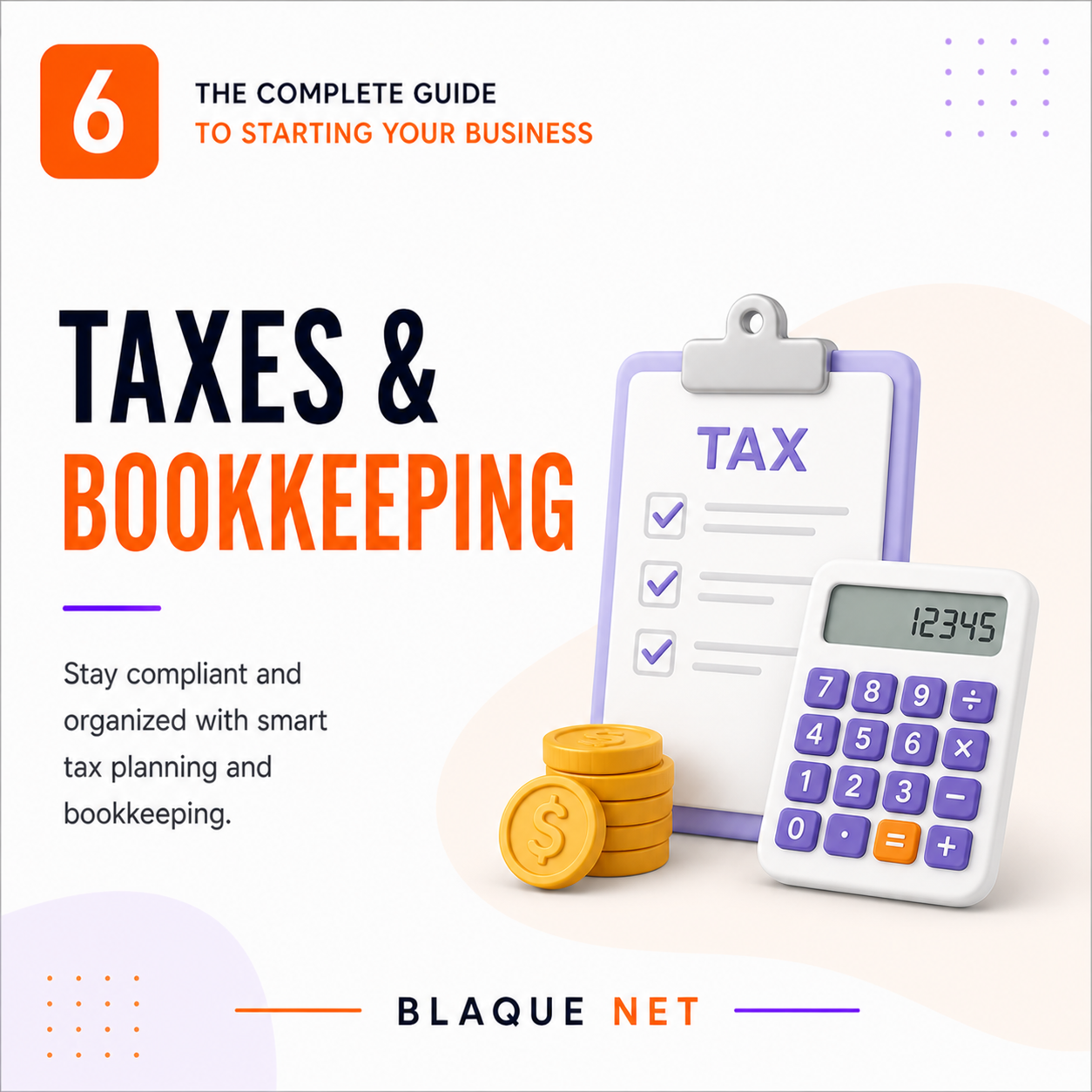
💵 Taxes & Bookkeeping Basics
Know what you owe, track what you spend, and keep more of what you earn. Here's how to build the financial discipline that keeps your business IRS-compliant and out of crisis.
Why Your Books Matter More Than Your Logo
Every dollar that moves through your business needs to be tracked — not because the IRS requires it (though they do) — but because you cannot make smart decisions with invisible numbers. Clean books are the foundation of everything: funding applications, tax preparation, strategic decisions, and knowing whether your business is actually working.
📄 Your Business Structure Determines Your Tax Reality
How you're taxed depends entirely on your legal structure. This isn't one-size-fits-all — different structures mean different forms, different rates, and completely different obligations. (If you haven't chosen your structure yet, see Post 4.)
| Structure | How Taxed | IRS Form | SE Tax? | Filing Deadline |
|---|---|---|---|---|
| Sole Proprietor | Personal return | Schedule C (1040) | 15.3% on all profit | April 15 |
| Single-Member LLC | Disregarded entity | Schedule C (1040) | 15.3% on all profit | April 15 |
| Multi-Member LLC | Partnership | Form 1065 + K-1s | On distributive share | March 15 |
| S-Corporation | Pass-through | Form 1120-S + K-1 | Salary portion only | March 15 |
| C-Corporation | Corporate (21%) | Form 1120 | No SE tax | April 15 |
| 501(c)(3) Nonprofit | Exempt (mission income) | Form 990 / 990-EZ / 990-N | N/A | 15th day, 5th month after fiscal year end |
Once your LLC nets $50K–$80K+ consistently, electing S-Corp status with the IRS (Form 2553) saves thousands annually by splitting profit into a reasonable salary (subject to payroll/SE taxes) and distributions (not subject to SE tax).
Example: $100K net profit. Without S-Corp: $15,300 in SE tax on the full amount. With S-Corp: $60K salary + $40K distribution = ~$9,180 SE tax. Annual savings: ~$6,120. The catch: requires payroll setup and a CPA. Worth it at this income level.
🏠 Step 1 — Set Up Your Financial Foundation
Before you track a single dollar, build the infrastructure. Everything that follows depends on these fundamentals being in place.
📅 Quarterly Estimated Taxes — Pay as You Earn
The IRS expects self-employed individuals and business owners to pay taxes throughout the year — not just in April. Missing these payments triggers underpayment penalties on top of whatever you owe. This isn't optional.
Take your estimated annual net profit × your effective tax rate (federal income tax + 15.3% SE tax − half of SE tax deduction). For most small business owners in the early stages, a safe starting estimate is 25–30% of net profit set aside quarterly. Once you have a year of history, your CPA can calculate a more precise figure.
Pay via: IRS Direct Pay (free, direct.irs.gov) or EFTPS (eftps.gov). Both are free. Never mail a check if you can avoid it — electronic payment provides confirmation and faster processing.
Annual Filing Deadlines
| Filing | Deadline | Extension | Who Files |
|---|---|---|---|
| Personal / Schedule C | April 15 | October 15 | Sole prop, single-member LLC |
| Partnership / S-Corp | March 15 | September 15 | Multi-member LLC, S-Corp |
| C-Corporation | April 15 | October 15 | C-Corp |
| 1099-NEC to contractors | January 31 | No extension | Anyone paying contractors $600+ |
| W-2 to employees | January 31 | No extension | Any business with employees |
| Florida Sales Tax | 20th of following month | Varies | FL businesses selling taxable goods |
🤑 Deductions You Should Be Taking
A deduction reduces your taxable income directly. Every dollar of legitimate deductions saves you your marginal tax rate in taxes. Most new entrepreneurs leave thousands on the table every year because they don't know what qualifies. Here's the full picture.
Deductible if you use a specific area of your home regularly and exclusively for business. Must be your principal place of business.
Simplified method: $5/sq ft, up to 300 sq ft ($1,500 max). Actual method: Proportional share of rent/mortgage, utilities, internet, insurance, and depreciation. Calculate both and take the larger.
Every mile driven for business — client meetings, supply runs, bank trips, business events — is deductible.
Standard mileage rate: 70¢/mile (2025). Actual expense method: Proportion of actual vehicle costs (gas, insurance, depreciation). Track every trip with MileIQ, TripLog, or a mileage log. Commuting to a regular office is not deductible.
Every subscription, app, platform, and tool used for business is deductible: accounting software, CRM, project management, design tools, hosting, domains, email marketing, cloud storage.
100% deductible. Keep subscription receipts and document the business purpose for each.
Paid ads, branded materials, website costs, photography, video production for business, social media management tools, promotional items, PR services.
100% deductible. Document the business purpose. Includes sponsored posts, Google Ads, Meta Ads, and influencer payments.
Courses, certifications, books, workshops, conferences, and industry events that maintain or improve skills in your current business.
Deductible when related to your existing business. Education to qualify for a new career is not deductible. Industry conferences, coaching programs, and professional memberships all count.
CPA fees, attorney fees, business coaches, financial advisors, consultants — all deductible in the year paid. Even the cost of tax preparation is deductible.
Keep all invoices. Fees paid to start a business (legal, filing, consulting) may need to be amortized rather than fully deducted in year one — ask your CPA.
50% of the cost of meals with clients, prospects, or business partners where a business discussion takes place. Document: who attended, date, location, business purpose.
Important: Entertainment (concerts, sporting events) is NOT deductible since the 2017 Tax Cuts and Jobs Act. Meals are still 50% deductible. Keep separate receipts for food and entertainment at the same event.
Flights, hotels, rental cars, and transportation for trips where the primary purpose is business. Mixed trips: business days are deductible, personal days are not.
Keep your itinerary and receipts. Document meetings, conferences, or client work that justify each trip. Tip: book the business purpose before the leisure extension to establish the primary purpose.
Self-employed individuals can deduct 100% of health, dental, and vision insurance premiums paid for themselves, their spouse, and dependents — as an above-the-line deduction.
Taken on Schedule 1 of your 1040, not Schedule C. Cannot exceed your net self-employment income for the year. Does not apply if you were eligible for employer-sponsored coverage through a spouse's employer.
If you rent office, studio, retail, or commercial space for business, the full rent and associated utilities are 100% deductible.
Coworking memberships count. Keep all lease agreements and monthly invoices. If you use the space for both personal and business (like a mixed-use studio), allocate the business percentage and deduct only that portion.
Equipment, computers, cameras, machinery, and furniture used for business. Under Section 179, you can deduct the full cost in the year purchased rather than depreciating over years.
2025 Section 179 limit: $1.22M. Bonus depreciation also available for qualifying assets. Consult your CPA for large equipment purchases — the timing strategy matters.
Business bank account fees, merchant processing fees, business loan interest, and business credit card interest are all deductible.
Personal loan interest is not deductible even if you used the funds for business. Keep a clear record of what business loans you have and the interest paid each year (your lender will send a 1098 or equivalent).
The Qualified Business Income (QBI) deduction allows eligible self-employed individuals and pass-through business owners to deduct up to 20% of qualified business income from their taxable income. Created by the 2017 Tax Cuts and Jobs Act.
Eligibility has income limits and phase-outs, and some service businesses (law, financial services, consulting at higher income levels) face restrictions. This is one of the most valuable deductions available to small business owners and one of the most misunderstood. Ask your CPA specifically about your QBI eligibility every year.
🔄 Your Bookkeeping Rhythm — Weekly, Monthly, Quarterly
Bookkeeping is a habit, not a once-a-year scramble. Build this into your operating schedule and tax season becomes a formality instead of a crisis.
- Review and categorize all imported bank/card transactions
- Upload receipts from the week (photo or scan)
- Send any outstanding invoices
- Log any cash expenses not captured on card
- Check accounts receivable — who owes you money?
- Reconcile bank accounts (match software to bank statement)
- Review P&L: are you profitable? Where are expenses growing?
- Review cash flow statement: do you have enough cash on hand?
- Transfer 25–30% of net income to tax reserve if not already automated
- Check on contractor payments — will any hit the $600 1099 threshold?
- Pay estimated taxes to the IRS (April 15, June 15, Sept 15, Jan 15)
- Run quarterly P&L and balance sheet — compare to prior quarter
- Review YTD performance against your annual plan
- Check in with your CPA or bookkeeper
- Reconcile payroll records if you have employees
💰 Owner Pay, Retirement & Personal Finance for Entrepreneurs
Being your own boss means nobody is setting up your retirement, matching your contributions, or withholding enough tax. You have to build these systems yourself — and the sooner you start, the more powerful they become.
How to Pay Yourself Correctly by Structure
Retirement Options for Self-Employed Business Owners
Every dollar contributed to a qualifying retirement account reduces your taxable income dollar-for-dollar. This is simultaneously a tax strategy and a wealth-building strategy. Start as soon as you have consistent profit.
2025 limit: Up to 25% of net self-employment income, max $70,000.
Simple to set up, flexible contributions (you decide each year), no annual filing required. The most popular option for solo founders and profitable LLCs. Open at Fidelity, Vanguard, or Schwab.
2025 limit: Up to $70,000 total ($23,500 employee + up to 25% employer contribution).
Highest contribution limits available. For self-employed individuals with no full-time employees (other than a spouse). Allows Roth contributions. Requires Form 5500-EZ if plan assets exceed $250K. Best for high-income solo founders.
2025 limit: $16,500 employee deferral + employer match (2–3% of compensation).
Good for businesses with employees. Lower contribution limits than Solo 401(k) or SEP-IRA. Mandatory employer contribution required. Simpler administration than a full 401(k) plan.
2025 limit: $7,000 ($8,000 if 50+). Income phase-out begins at $150K (single) / $236K (married).
After-tax contributions, tax-free growth and withdrawals in retirement. Not technically a business account, but extremely powerful for business owners in lower-income early years before income limits kick in. Max this before other accounts if you qualify.
Health Insurance for Self-Employed Entrepreneurs
👥 DIY vs. Hire a Pro — When to Make the Switch
- Revenue under $150K/year
- Simple business model (service, freelance)
- No employees — only contractors or solo
- Single revenue stream, minimal COGS
- You have 1–2 hours/month to maintain it
- Books are 3+ months behind
- You have employees or payroll
- Multiple revenue streams or inventory
- Applying for loans or grants requiring clean financials
- You dread it enough to avoid it (avoidance is expensive)
- Revenue crosses $250K–$500K
- Considering S-Corp election
- You receive an IRS notice or audit
- Taking on investors or selling the business
- Complex deduction strategy (QBI, Section 179, retirement)
🔒 IRS Audit Triggers — What to Avoid
The IRS audits a small percentage of returns each year, but certain patterns dramatically increase your odds of being selected. Knowing what triggers scrutiny helps you stay clean while still taking every deduction you're entitled to.
✅ Your Section 6 Checklist
🎯 Quick-Scan Summary
- Your structure determines your tax reality — sole prop/LLC (Schedule C), S-Corp (1120-S), C-Corp (1120), nonprofit (990).
- Set aside 25–30% of every payment for taxes immediately. Transfer it to a separate account. Treat it as already spent.
- Quarterly estimated taxes: April 15, June 15, September 15, January 15. Extensions extend the filing deadline, not the payment deadline.
- The deductions most overlooked: home office, mileage, health insurance premiums, retirement contributions, and the QBI deduction (up to 20% off taxable income).
- Bookkeeping is a weekly habit, not an annual scramble. 20–30 minutes/week prevents the 40-hour year-end nightmare.
- Collect W-9s before you pay contractors. File 1099-NECs by January 31. Missing this costs you the deduction and triggers a penalty.
- Open a SEP-IRA or Solo 401(k) as soon as profit is consistent. Every dollar contributed reduces your taxable income dollar-for-dollar.
- A good CPA finds more than they cost. Find one before you need one urgently.
Last Updated: May 2026 · Blaque Net Start Your Business Series
Want to Know Where You Stand Financially? 🤖
Business Buddy can assess your capital readiness, help you identify tax strategy gaps, and map your path to funding — in minutes.
Open Business Buddy →
 English
 Arabic
 French
 Spanish
 Portuguese
 Deutsch
 Turkish
 Dutch
Dutch
 Italiano
 Russian
 Romaian
 Portuguese (Brazil)
 Greek
Greek