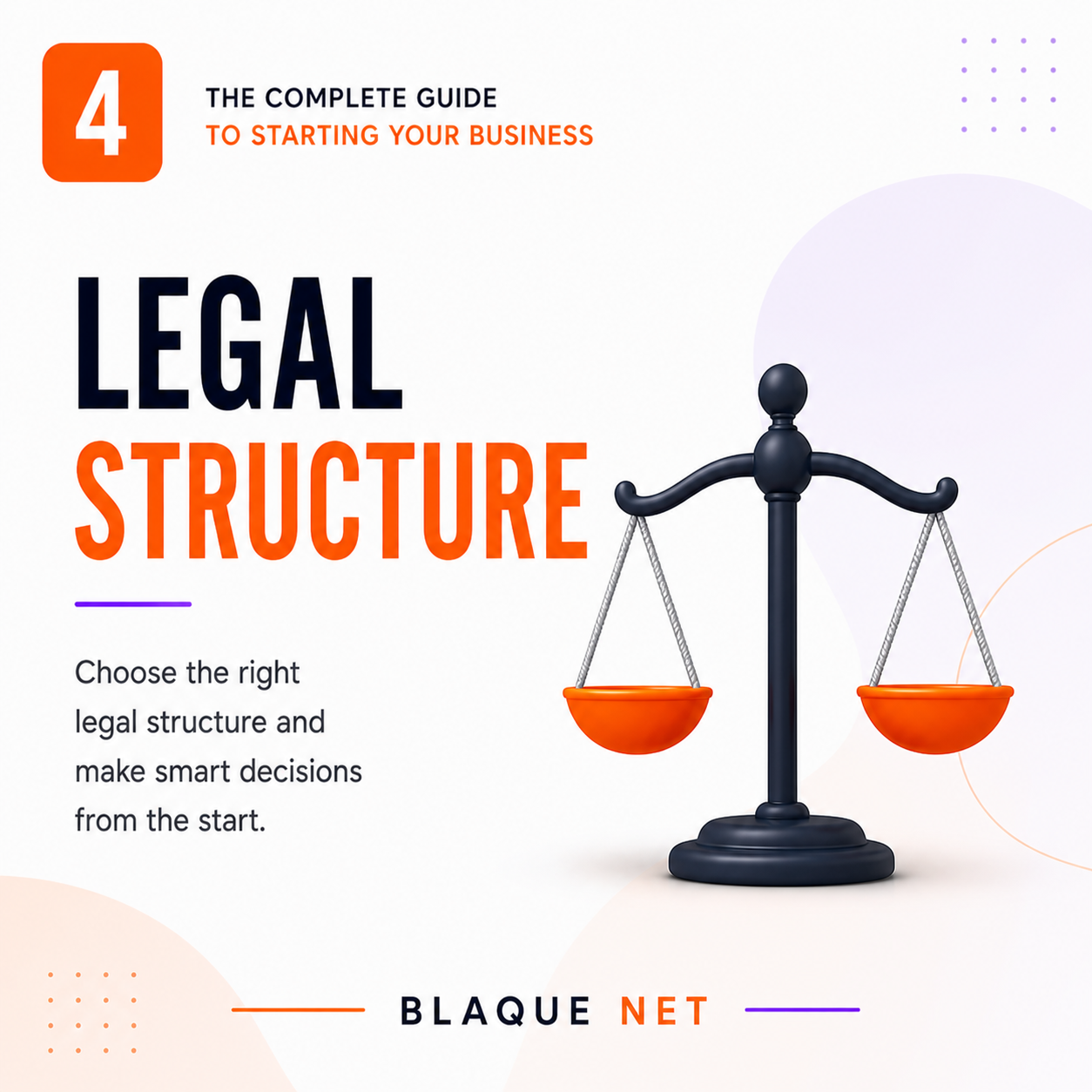
Your legal structure determines your liability, your taxes, and your ability to grow. Get this right early — it's far cheaper than fixing it later.
Checklist — 12 action itemsCheck each item as you complete it
Blaque Net — Part 4 of 10. One of the first real decisions you make as a business owner isn't about your product or your customers — it's about your legal foundation. Get it wrong and you pay for it in taxes, lawsuits, or blocked funding. Get it right and it protects you for years.
Why Your Legal Structure Is a Business Decision, Not a Formality
Most people choose their business structure because someone told them "just form an LLC" or because it was the first option they saw. That's not a strategy — that's luck. Your structure dictates three critical things:
🛡️ Personal Liability Are your personal assets — home, car, savings — protected if someone sues your business or your business can't pay its debts? The answer depends entirely on your structure.
💵 How You're Taxed Self-employment tax, pass-through income, corporate rates, payroll requirements — your structure determines how much you keep after taxes and what forms you file every year.
📈 Growth & Funding Access Certain structures can't take on investors. Others lock you out of specific grants. Some make lenders uncomfortable. Know this before you build on a foundation that limits where you can go.
🔴 The real risk: Operating without a formal structure means you are the business. Every debt, lawsuit, and liability is yours personally. One bad client, one slip-and-fall at your location, one missed contract clause — and your personal finances are on the table.
The 5 Business Structures — What They Actually Mean
Sole ProprietorshipNo formal filing required
You and the business are legally the same entity. No separation, no paperwork to form, no annual fees. You report all business income and expenses on Schedule C of your personal tax return.
✅ Pros
Zero formation cost or paperwork
Simplest taxes (Schedule C only)
Full control, no compliance requirements
❌ Cons
Zero liability protection — you are personally responsible for all debts and lawsuits
Full 15.3% self-employment tax on all net profit
Harder to get business credit or loans
Does not end if you do — no continuity
Best for: Freelancers and side hustlers testing an idea before committing to formation. Not a long-term strategy once you have real revenue, clients, or any physical risk.
LLCLimited Liability Company — Most common for small business⭐ Most Popular
A legal entity separate from you. Your personal assets are protected from business liabilities. By default, a single-member LLC is taxed the same as a sole proprietorship (pass-through), but you have liability protection the sole prop doesn't offer. Multi-member LLCs file as partnerships by default.
✅ Pros
Personal assets protected from business debts & lawsuits
Simple pass-through taxation by default
Can elect S-Corp taxation when revenue justifies it
Flexible management structure
Credibility — "LLC" signals a real business
Relatively low formation cost ($50–$250 depending on state)
❌ Cons
Self-employment tax (15.3%) still applies to all net profit until S-Corp election
Annual state fees and reports required
Cannot issue stock — not ideal for VC funding
Liability protection disappears if you mix personal and business funds ("piercing the veil")
Best for: Most small business owners, solo founders, service providers, consultants, and anyone who wants liability protection without complex compliance. The right starting point for the majority of entrepreneurs.
⚠️ Florida note: Florida LLCs require an annual report filed with the Division of Corporations by May 1 each year. Missing it results in a $400 late fee and eventually administrative dissolution. Set a calendar reminder. File at sunbiz.org.
S-CorporationTax election, not a separate entity typeTax Saver
An S-Corp is not a separate business structure — it's a tax election that an LLC or Corporation can make with the IRS (Form 2553). When you elect S-Corp status, the business's profit splits into two buckets: your salary (subject to payroll taxes) and distributions (not subject to self-employment tax). At sufficient income levels, this saves thousands annually.
💵 The S-Corp Tax Math
Without S-Corp (LLC taxed as sole prop): $100K profit × 15.3% SE tax = $15,300 in SE tax alone.
With S-Corp: $60K salary + $40K distribution. SE tax only on the $60K salary = $9,180. Savings: ~$6,120/year.
The catch: you must pay yourself a "reasonable salary" — the IRS will challenge an artificially low salary. You also need payroll setup (Gusto, Rippling) and more accounting complexity. The math typically justifies the switch around $50K–$80K+ in net profit.
✅ Pros
Significant SE tax savings at higher income
Distributions not subject to payroll taxes
Pass-through taxation (no double tax)
❌ Cons
Requires payroll setup and W-2 to yourself
More accounting complexity — CPA typically needed
100 shareholder limit, one class of stock only
Not ideal for raising venture capital
Best for: Established, profitable LLCs or corporations generating $50K+ in net profit annually and looking to reduce SE tax burden. Not a starting point — a growth-stage optimization.
C-CorporationFor investor-backed ventures
A fully separate legal entity taxed at the corporate level (21% flat federal rate). Profits distributed to shareholders as dividends are taxed again on the personal return — this is the "double taxation" C-Corps are known for. However, C-Corps can issue multiple classes of stock, take on unlimited investors, and are the required structure for most venture capital and institutional investment.
✅ Pros
Can issue preferred stock — required for VC
No limit on number of shareholders
Easier to raise institutional capital
Retained earnings taxed at 21% corporate rate (lower than personal rate at higher incomes)
❌ Cons
Double taxation on dividends
Most complex compliance, reporting, and legal requirements
Highest accounting and legal costs
Overkill for most small businesses
Best for: Startups that plan to raise venture capital or eventually go public. Delaware C-Corp is the default requirement for most VC term sheets. Not recommended for typical small businesses.
PartnershipGeneral & Limited
A General Partnership (GP) forms automatically when two or more people do business together for profit — even without a written agreement. Both partners share unlimited personal liability. A Limited Partnership (LP) has at least one general partner with unlimited liability and limited partners whose liability is capped at their investment.
⚠️ Important: A general partnership without a written partnership agreement is one of the riskiest ways to run a business. Disputes over profits, decision-making, and exit rights destroy partnerships — and friendships — constantly. If you're starting with a partner, form a multi-member LLC and create an operating agreement instead. Same tax treatment, far better protection.
Best for: Multi-member LLCs are almost always the better alternative. LPs are used in real estate and private equity fund structures. General partnerships are rarely the right choice.
Side-by-Side Comparison
Factor
Sole Prop
LLC
S-Corp
C-Corp
Personal liability protection
❌ None
✅ Yes
✅ Yes
✅ Yes
Self-employment tax on profit
15.3% all
15.3% all
Salary only
No SE tax
Pass-through taxation
✅ Yes
✅ Yes
✅ Yes
❌ Double tax
Can raise investor capital
Limited
Some
Limited
✅ Yes (VC-ready)
Formation cost (approx.)
$0
$50–$250
$50–$250 + CPA
$200+ + attorney
Compliance complexity
Minimal
Low–moderate
Moderate
High
Best revenue stage
Pre-launch
All stages
$50K+ profit
VC-track
📄 Getting Your EIN — Free, Fast, Non-Negotiable
An EIN (Employer Identification Number) is your business's Social Security number. You need it to open a business bank account, hire employees, apply for most business licenses, file business taxes, and apply for most grants and loans. It's free and takes 5 minutes.
1
Go to IRS.gov/EINUse the online application only — never pay a third-party service to get an EIN. It's completely free directly from the IRS.
2
Select your entity typeMatch it to your legal structure (sole proprietor, LLC, corporation, etc.). This affects how the EIN is categorized in IRS records.
3
Complete the online form (5–10 minutes)You'll need your SSN or ITIN as the responsible party. Answer the questions about your business purpose and expected employees.
4
Download and save your EIN confirmation letterYou'll get it immediately on screen. Download the PDF and save it — you'll need this letter for bank accounts, licenses, and applications. The IRS can take weeks to mail a paper copy if you lose the digital one.
📝 Operating Agreement — Even If You're a Solo Founder
An LLC Operating Agreement is the internal governing document of your business. Most states don't legally require one for a single-member LLC — which is exactly why most people skip it. Don't.
🏠 Bank Accounts Many banks require an operating agreement to open a business checking account. Having one ready prevents delays.
🛡️ Liability Shield A documented operating agreement reinforces that the LLC is separate from you personally — which is critical if the liability protection is ever challenged in court.
🤝 Partner Disputes For multi-member LLCs: the operating agreement defines profit splits, decision-making authority, what happens if a partner wants out, and what happens if a partner dies. Without it, state default rules apply — which almost never reflect what you actually agreed to.
💰 Funding & Grants Many grant applications and lenders ask for your operating agreement as part of the application package. Not having one creates friction at the worst possible time.
💡 Where to get one: For a single-member LLC, a template operating agreement (free from your state's SOS website or sites like Rocket Lawyer, LegalZoom, or Northwest Registered Agent) is sufficient to start. For multi-member LLCs, have an attorney review it — the cost of a proper agreement is a fraction of the cost of a partner dispute.
📋 Registered Agent — What It Is and Why It Matters
Every LLC and corporation must designate a registered agent — a person or service that receives official legal documents, IRS correspondence, and state notices on behalf of the business.
🧑 You (DIY) You can be your own registered agent if you have a physical address in the state of formation and are available during business hours. Downside: your address becomes public record.
💼 Registered Agent Service Services like Northwest Registered Agent, ZenBusiness, or Incfile charge $50–$150/year to receive and forward your legal documents. Keeps your home address off public record. Worth it for most founders.
📋 Business Licenses & Permits — What You Actually Need
Forming an LLC does not automatically license you to do business. Depending on your industry and location, you may need additional licenses, permits, or registrations.
🌎 Federal LevelMost businesses don't need a federal license. Exceptions: agriculture, firearms, alcohol, broadcasting, transportation, investment advising, and certain import/export activities. Check with the relevant federal agency for your industry.
🏠 State Level (Florida-specific)Florida does not have a general state business license, but many professions require state licensure: contractors, real estate agents, cosmetologists, healthcare providers, food handlers, insurance agents, attorneys, CPAs, and more. Check the Florida Department of Business & Professional Regulation (DBPR) at myfloridalicense.com for your specific profession.
🏢 County & City LevelMost Florida businesses need a local Business Tax Receipt (formerly Occupational License) from their county and/or city. In Broward County, this is required for most commercial activity. Check with Broward County Revenue Collection Division and your city's business services office.
📋 Sales Tax RegistrationIf you sell taxable goods or services in Florida, you must register with the Florida Department of Revenue (floridarevenue.com) and collect and remit sales tax. Florida's general sales tax rate is 6%, with some counties adding a local surtax. Services are generally not taxable in Florida (unlike most states), but physical products are.
🧹 DBA — Doing Business As
A DBA (also called a "fictitious name" in Florida) lets you operate your business under a name that's different from your legal entity name. Example: Your LLC is "JDT Consulting LLC" but you want to brand as "Summit Strategy Group." You'd file a fictitious name registration for the brand name.
Florida Filing File a fictitious name registration with the Florida Division of Corporations (sunbiz.org). Cost: $50. Renewal: every 5 years.
What It Does NOT Do A DBA/fictitious name does not protect your business name from being used by others. For that, you need a state or federal trademark.
When You Need It Whenever the name you're marketing under doesn't exactly match your legal entity name. Also required if you want to open a bank account under a brand name.
🔑 Intellectual Property Basics
Your business name, logo, products, and content can all be legally protected. Here's what you need to know before you invest heavily in a brand.
™ Trademark Protects your brand name, logo, and slogan in connection with specific goods or services. Federal registration through the USPTO gives you nationwide protection and legal leverage. Cost: $250–$400/class. Search before you brand: tmsearch.uspto.gov
📎 Patent Protects inventions, processes, and product designs. Utility patents: 20 years. Design patents: 15 years. Expensive ($5K–$15K+ with an attorney) and complex. If you have a truly novel product, consult a patent attorney early.
🔒 Trade Secret Confidential business information that gives you a competitive edge (formulas, processes, customer lists). Protected through NDAs and security practices, not registration. Requires active steps to keep it secret — disclosure can forfeit protection.
📋 Essential Business Contracts
A handshake is not a contract. Every client relationship, partnership, and vendor arrangement that matters should be documented. These are the contracts most small businesses need from the start.
Client Service Agreement Defines scope of work, deliverables, timeline, payment terms, revision limits, IP ownership, and what happens if either party doesn't perform. Use for every client engagement without exception.
Independent Contractor Agreement When you hire anyone as a 1099 contractor. Establishes the contractor status, scope, payment, IP ownership, and confidentiality. Critical to avoid worker misclassification liability.
Non-Disclosure Agreement (NDA) Use when sharing sensitive business information with potential partners, employees, or vendors. Specifies what's confidential, what the receiving party can do with it, and for how long the obligation lasts.
Terms of Service & Privacy Policy Required if you have a website, app, or any digital product that collects user data. The Privacy Policy is a legal requirement under various state laws (Florida, California, etc.) and required by payment processors like Stripe.
Partnership / Operating Agreement If you have a co-founder or business partner, this defines ownership percentages, decision-making authority, profit distribution, and what happens if someone wants to leave. Non-negotiable for any multi-owner business.
Letter of Intent (LOI) Used before finalizing major partnerships, acquisitions, or real estate leases. Sets out the key terms both parties agree to negotiate in good faith before a full contract is drafted.
💡 Template sources: Contracts can be drafted from templates (Rocket Lawyer, Docracy, LegalZoom, or your state bar's free resources) and customized for your business. For high-stakes contracts — partnership agreements, significant client deals, IP licensing — spend the money on an attorney review. One poorly written contract that goes to dispute will cost far more than the legal fees you saved.
🌟 Nonprofit Organizations — A Different Path Entirely
A nonprofit is not just a business that doesn't make money. It's a distinct legal structure with its own formation process, tax treatment, governance requirements, and compliance obligations. If your mission is public benefit rather than personal profit, this is the path.
The Core Difference
A for-profit business exists to generate profit for its owners. A nonprofit exists to serve a public or charitable purpose — and any surplus revenue must be reinvested into the mission, not distributed to owners or shareholders.
This doesn't mean nobody gets paid. Nonprofit staff, executives, and founders can receive reasonable compensation. What they can't do is personally pocket the organization's profits.
The Most Common Nonprofit Tax-Exempt Categories
501(c)(3)
Charitable, Religious, Educational, ScientificThe most common and most powerful nonprofit designation. Donations are tax-deductible to donors. Eligible for government grants, foundation grants, and most charitable funding. Required for most institutional philanthropy. Includes public charities and private foundations. This is what BNEEF is.
501(c)(4)
Social Welfare OrganizationsCommunity benefit organizations that can engage in more political activity than a 501(c)(3). Donations are generally not tax-deductible. Used for civic leagues, advocacy groups, and community action organizations.
501(c)(6)
Business Leagues, Chambers of Commerce, Trade AssociationsMembership organizations that promote a common business interest. Dues and contributions are not tax-deductible as charitable contributions but may be deductible as business expenses. Used by industry associations and chambers of commerce.
501(c)(7)
Social & Recreational ClubsOrganized for pleasure, recreation, or other similar nonprofit purposes. Membership-funded. Not eligible for tax-deductible donations.
How to Form a 501(c)(3) — Step by Step
1
Choose a name and check availabilityYour nonprofit name must be distinguishable from other registered entities in your state. Search at sunbiz.org (Florida) and do a federal trademark check. Also check that the domain and social handles are available.
2
Appoint a board of directorsA 501(c)(3) must have a board of directors — not just a founder. Florida requires a minimum of 3 directors. Board members provide governance oversight and are legally responsible for the organization. They typically serve without compensation (though staff roles can be separate). Choose people who add expertise, connections, or credibility — not just supporters.
3
File Articles of Incorporation with your stateIn Florida, file with the Division of Corporations at sunbiz.org. Filing fee: $70. Your Articles must include a specific nonprofit purpose statement and a dissolution clause stating assets go to another exempt organization if you close — both required by the IRS for 501(c)(3) eligibility.
4
Draft your bylawsBylaws are the internal rules governing the organization: how the board operates, how officers are elected, how meetings are conducted, voting procedures, and conflict of interest policies. You'll need these for the IRS application and most grant applications. Templates are available; a nonprofit attorney review is worth the cost.
5
Get your EINSame process as a for-profit — free at IRS.gov. Select "Corporation" as the entity type for a nonprofit corporation. You'll need the EIN before filing your IRS application.
6
File for federal tax-exempt status with the IRSForm 1023-EZ (streamlined, online, $275 fee) — for organizations that expect to gross under $50K annually in their first 3 years and have total assets under $250K. Most startups qualify. Form 1023 (full application, $600 fee) — for larger or more complex organizations. Requires detailed program descriptions, financials, and governance documents. Processing time: 3–6 months average.
7
Register for state charitable solicitation (if fundraising in Florida)Florida requires nonprofits that solicit donations from the public to register with the Florida Department of Agriculture and Consumer Services (FDACS) before fundraising. Registration fee: $10–$400 based on gross revenue. Annual renewal required. Your registration number goes on all fundraising materials.
8
Open a nonprofit bank account and set up financial systemsYou'll need your EIN, Articles of Incorporation, and IRS determination letter (or pending application). Maintain separate accounts for general operating funds and any restricted grant funds. Fund accounting — tracking income and expenses by program and grant — is required for most funders and nonprofit best practice.
Ongoing Compliance — What Keeps Your 501(c)(3) Status
📋 IRS Form 990 (Annual) All 501(c)(3)s must file an annual information return with the IRS. Form 990-N (e-Postcard) for orgs under $50K gross receipts. Form 990-EZ for $50K–$200K. Full Form 990 for $200K+. Missing 3 consecutive years results in automatic revocation of tax-exempt status.
🏠 Florida Annual Report Same as for-profit entities — file by May 1 each year at sunbiz.org. $61.25 filing fee for nonprofits. Missing it results in administrative dissolution.
💰 Charitable Solicitation Renewal Florida charitable solicitation registration must be renewed annually with FDACS. Renewal deadlines are based on your fiscal year end. Late fees apply.
👥 Board Governance Hold regular board meetings (at minimum annually), keep meeting minutes, maintain a conflict of interest policy, and document all major decisions. The IRS and most funders will ask for evidence of active governance.
🚫 Private Benefit & Inurement No part of the nonprofit's net earnings can benefit any private individual, including the founder. Reasonable compensation for services rendered is allowed — but must be documented, approved by the board, and comparable to market rates. Excessive compensation is a serious compliance violation.
🚫 Political Activity Limits 501(c)(3)s are absolutely prohibited from endorsing or opposing political candidates. Limited lobbying for legislation is allowed but restricted. Violating this rule can result in loss of tax-exempt status.
Nonprofit vs. For-Profit — Key Differences at a Glance
Factor
For-Profit (LLC)
501(c)(3) Nonprofit
Purpose
Generate profit for owners
Serve a public/charitable mission
Federal income tax
Taxable (pass-through or corporate)
Exempt on mission-related income
Donations tax-deductible
❌ No
✅ Yes
Eligible for foundation & gov grants
Limited
✅ Broad access
Profit distribution to owners
✅ Yes
❌ Prohibited
Staff compensation allowed
✅ Yes
✅ Yes (reasonable & documented)
Board of directors required
Not typically
⚠ Required (min. 3 in FL)
Annual IRS filing
Tax return (1040/1065/1120)
Form 990 (information return)
💡 Can I run a nonprofit and a for-profit together?
Yes — this is called a hybrid or parallel structure and it's common. The nonprofit handles the charitable mission and accesses grant funding. The for-profit handles revenue-generating activities. They must operate as genuinely separate entities with separate finances, governance, and clear boundaries. The for-profit cannot improperly benefit from the nonprofit's tax-exempt status. Consult an attorney when structuring this relationship.
⚠️ How to Lose Your Liability Protection (Piercing the Veil)
Forming an LLC gives you liability protection — but it's not automatic once it's granted, it's conditional. Courts can hold you personally liable ("pierce the corporate veil") if you treat the business as an extension of yourself rather than a separate entity. Here's what to avoid:
❌ Mixing personal & business funds Using your business account for personal expenses or paying business expenses from personal accounts destroys the separation that protects you.
❌ Undercapitalization Starting a business without enough capital to operate is a red flag. Courts view it as a sign the entity was created to defraud creditors, not to run a real business.
❌ No operating agreement or records Failing to maintain basic corporate formalities — no operating agreement, no records of major decisions — signals the entity is not operating as a real business.
❌ Fraud or misrepresentation Using the business entity to commit fraud or misrepresent facts to creditors is the surest path to personal liability, regardless of structure.
Sole proprietorship = zero protection. LLC = the right starting point for most entrepreneurs.
S-Corp is a tax election, not a separate entity — consider it when net profit consistently exceeds $50K–$80K.
Form your LLC with your state → get your EIN for free → open a dedicated business bank account. In that order.
An operating agreement protects you even as a solo founder — banks and grants often require it.
Florida LLC: file the annual report by May 1 every year. $400 late fee if you miss it.
Search USPTO before finalizing your brand name. A trademark conflict after you've built the brand is expensive.
Use a client contract for every engagement. No exceptions. A handshake is not a contract.
Never mix personal and business funds — it's the #1 way to lose your LLC's liability protection.
📋 Disclaimer: Educational purposes only — not legal, financial, or professional advice. Business laws vary by state. Always consult a qualified attorney for your specific situation. Blaque Net does not guarantee specific outcomes.
Last Updated: May 2026 · Blaque Net Start Your Business Series
Questions About Your Structure or Legal Setup? 🤖
Business Buddy can help you think through your options, map compliance requirements, and identify what you need to get capital-ready.
For most new entrepreneurs, an LLC is the best starting structure — personal liability protection, flexible taxes, and credibility with lenders and grant reviewers. Sole props are simpler but offer no liability protection and are harder to fund. Corporations are best for equity investment.
LLC vs. sole proprietorship — what's the real difference?
An LLC separates your personal assets from the business — if sued, your savings and property are protected. A sole prop has no separation. For funding, LLCs are far more credible: most grants, CDFI loans, and SBA programs require or strongly prefer a registered legal entity.
How does my legal structure affect getting a grant?
Directly. Most grant programs require a legally registered business — an EIN and state registration at minimum. SBA loans require a registered entity. CDFI lenders prefer LLCs or corporations. Register before applying — it's what makes you eligible for the majority of programs.
When should I register my business?
As soon as you have a validated idea and your first paying customer — or before if you want a business bank account or to apply for funding. Registration costs $50–$150 in most states and takes 1–5 days. EIN is free and instant at irs.gov. Don't wait to feel ready — registration is what makes you ready.
Does my legal structure affect my Capital Readiness Score?
Yes. Business registration is one of the first dimensions measured by the Capital Readiness Score in Capital OS — the AI Funding Intelligence platform on Blaque Net. A registered business with an EIN scores higher on Business Viability and unlocks access to far more funding programs.
Capital OS — AI Funding Intelligence
See your funding options based on your legal structure
Free Capital Readiness Score · Matched funding opportunities

 Resumé

 Arabic
 English
 French
 Spanish
 Portuguese
 Deutsch
 Turkish
 Dutch
Dutch
 Italiano
 Russian
 Romaian
 Portuguese (Brazil)
 Greek
Greek