
- Новости
- ИССЛЕДОВАТЬ
- Businesses
- Reels
- Resources
- Blaque Market
- Offers
-
 Resumé
🧠 Are You Ready to Be an Entrepreneur?
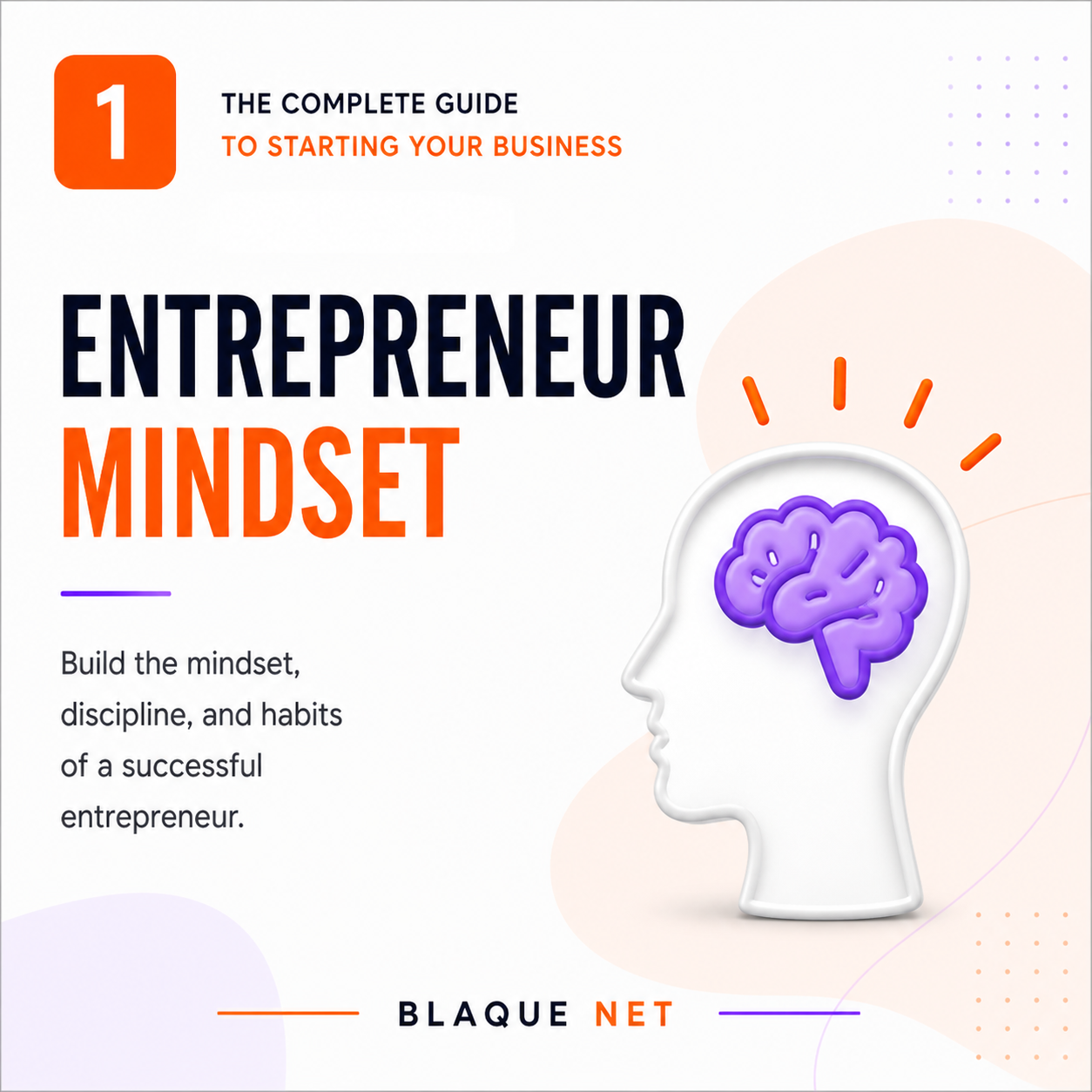
🧠 Are You Ready to Be an Entrepreneur?
Honest answers — with a real scored assessment — before you spend a dime.
The Real Talk First
Entrepreneurship looks amazing on social media — your own hours, your own boss, build wealth on your terms. All of that is real and possible. But it is also one of the hardest things you will ever do. The #1 reason businesses fail isn't a bad idea. It's a founder who wasn't prepared for what was actually required.
This section exists to help you go in with your eyes wide open — so you can prepare for what's real instead of being blindsided by it.
✅ The Real Upside
- Build something that's entirely yours
- Unlimited income ceiling
- Flexibility to design your schedule
- Tax advantages unavailable to employees
- Create jobs and community impact
- Build generational wealth
- Work with people you choose
- Your effort directly equals your reward
⚠️ The Reality Check
- Inconsistent income — especially Year 1
- You wear every hat at the start
- No paid time off, sick days, or employer benefits
- Requires self-discipline without external accountability
- Personal finances can be affected by the business
- Loneliness and stress are real — plan for them
- Most businesses take 2–3 years to be truly profitable
- Close relationships may be tested during the grind
Your Entrepreneur Readiness Assessment
Answer all 10 questions honestly. Your score + result will calculate automatically and tell you exactly where to focus before you build.
📋 Rate each area 1–5 · 1 = Not at all · 3 = Somewhat · 5 = Absolutely
1. Financial resilience — I can handle income uncertainty for 6–12 months without serious panic or abandoning the plan.
2. Self-motivation — I don't need a boss or external accountability to take action consistently.
3. Resilience — I handle rejection, criticism, and setbacks without shutting down or giving up.
4. Learner's mindset — I am willing to learn skills I don't have yet: sales, finance, marketing, operations.
5. Support system — I have at least one person in my life who genuinely supports this decision.
6. Problem clarity — I can describe in one sentence the problem I'm solving and who has it.
7. Financial runway — I have 3–6 months of living expenses saved, or a clear bridge income plan.
8. Decision-making comfort — I can make important decisions without having every piece of information.
9. Emotional separation — A bad month or failure won't break my identity or make me quit entirely.
10. Work ethic — I am willing to outwork what I've ever done before for at least the first 1–2 years.
The 5 Things You Actually Need Before Day One
💰 1. Financial Runway
Most businesses don't turn a profit in month one. The general rule is 3–6 months of personal living expenses saved before going full-time. If you're starting part-time while still employed, that's not a failure — that's smart strategy. Many successful founders kept their job until the business consistently generated 50–70% of their salary for 3+ consecutive months before making the leap.
Ways to build runway faster: Eliminate one major expense (subscription stack, eating out, a car payment), take on contract work in your field to stockpile savings, pre-sell your service before quitting, or start a digital revenue stream (freelance, consulting) that builds cash before you fully launch.
🗓️ 2. Protected, Consistent Time
You don't need to quit your job to start. You need dedicated, non-negotiable time blocks — every week without fail. Even 10–15 focused hours per week builds a business. What kills businesses isn't lack of time — it's inconsistent effort. Two weeks on, two weeks off, then a restart is the pattern of businesses that never launch.
Protect: Early mornings before work, evenings after family time settles, or one full weekend day. Put it in your calendar as a recurring appointment. Treat it as seriously as a meeting with your most important client — because it is.
🧠 3. A Learner's Mindset (Expertise Not Required)
You don't need to know everything before you start. You need to be willing to learn what you don't know — and do it fast. You will need to learn sales. You will need to understand your finances. You will need to market your business. None of this is optional and all of it is learnable with free resources that exist right now.
Where to start learning for free: SCORE mentor sessions, SBA online courses, YouTube (search "small business [topic]"), your local library, Blaque Net's resource library, SBDC workshops. The information is not the barrier — consistent action is.
🤝 4. A Real Support System
Entrepreneurship can be genuinely lonely. You need at least one person in your corner — a partner, friend, co-founder, mentor, or community. Resistance from people close to you is one of the most underrated obstacles new founders face. Have the honest conversation with your household before you start. Friction at home while trying to build a business is a silent killer.
If you don't have it yet: Join a community of entrepreneurs (Blaque Net, local chamber, SCORE). Being around people who understand what you're building changes everything.
📋 5. Clarity on the Problem You're Solving
You don't need a finished product, a logo, or a business plan yet. But you do need one thing before anything else: "What exact problem am I solving, and who specifically has that problem?" One sentence. If you can't write it, that's your first work to do. Everything — your product, your marketing, your pricing, your pitch — flows directly from this answer.
What Type of Entrepreneur Are You?
Knowing your type shapes the right model, timeline, funding approach, and first moves. Most people start in one category and evolve over time — that's completely normal.
Key challenge: Your income stops when you stop working. Scaling requires systems or a team.
Key challenge: Managing margins, inventory, and standing out in a crowded market.
Key challenge: Building a consistent, predictable client pipeline.
Key challenge: Funding, finding product-market fit, timing, and surviving the long runway to profitability.
Common Fears — And the Truth About Each
- "I don't have enough money to start." — Many successful businesses launched under $500. Validate before you invest. The MVP principle: do the smallest thing that proves demand before spending significant money.
- "I'm not an expert yet." — You need to know more than the people you're helping — not more than everyone in the world. Expertise is built by doing. You learn faster in motion than in preparation.
- "What if I fail?" — Most successful entrepreneurs have failed at something. Failure is data — it tells you what to adjust. The businesses that succeed are usually the ones that failed faster and pivoted sooner. The only real failure is never trying.
- "There's too much competition." — Competition means the market exists and people are spending money in it. Your job is not to eliminate competition — it's to serve a specific customer better than the alternatives available to them.
- "I don't have connections." — Every successful networker started with zero. Connections are built one conversation at a time. The people you need to meet are at events, in communities, and one warm introduction away from where you already are.
- "I'm not tech-savvy / not a numbers person / not good at sales." — These are learnable skills, not fixed traits. You start weak at all of them and build. Nobody launches strong in every area. Start with your strength, hire or partner for your gaps when revenue allows.
- "The timing isn't right." — Timing is almost never perfect. The people waiting for perfect conditions are the people who never start. Start now with what you have. Refine continuously.
✅ Your Section 1 Checklist
Click each item to mark it complete. Track your progress at the top.
Identified my 2–3 lowest areas and what I'll do to address them before investing heavily.
Written down exactly how many months of expenses I have saved, or documented my bridge plan.
Not "when I have time" — specific, weekly, recurring blocks that I treat as non-negotiable.
Everyone impacted by this decision knows what I'm building, the timeline, and the financial plan.
"I solve [problem] for [specific type of person]." If I can't write this, that's my first task.
Solopreneur, product seller, service business, or scalable startup — and understand what that means for my strategy.
SCORE is free. Blaque Net community is free. Local SBDC is free. You don't have to do this alone.
Sales, marketing, finance, operations — pick your gaps and make a plan to close them.
🎯 Quick-Scan Summary
- Entrepreneurship is rewarding and genuinely hard — go in with eyes open, not rose-colored glasses
- You need: financial runway, protected time, learner's mindset, a support system, and problem clarity
- Take the scored assessment — your gaps are your first work to do, not something to ignore
- You don't need expertise to start. You need willingness to learn and consistent action.
- Know your entrepreneur type — it shapes your entire first-year strategy
- Fear is universal among founders. Action is the only thing that separates the ones who build from the ones who dream.
- Perfection paralysis kills more businesses than bad ideas. Start messy. Refine in motion.
Last Updated: April 2026 · Part 1 of 10 · Blaque Net Start Your Business Series

 Russian
 English
 Arabic
 French
 Spanish
 Portuguese
 Deutsch
 Turkish
 Dutch
Dutch
 Italiano
 Romaian
 Portuguese (Brazil)
 Greek
Greek