
- Новости
- ИССЛЕДОВАТЬ
- Businesses
- Reels
- Resources
- Blaque Market
- Offers
-
 Resumé
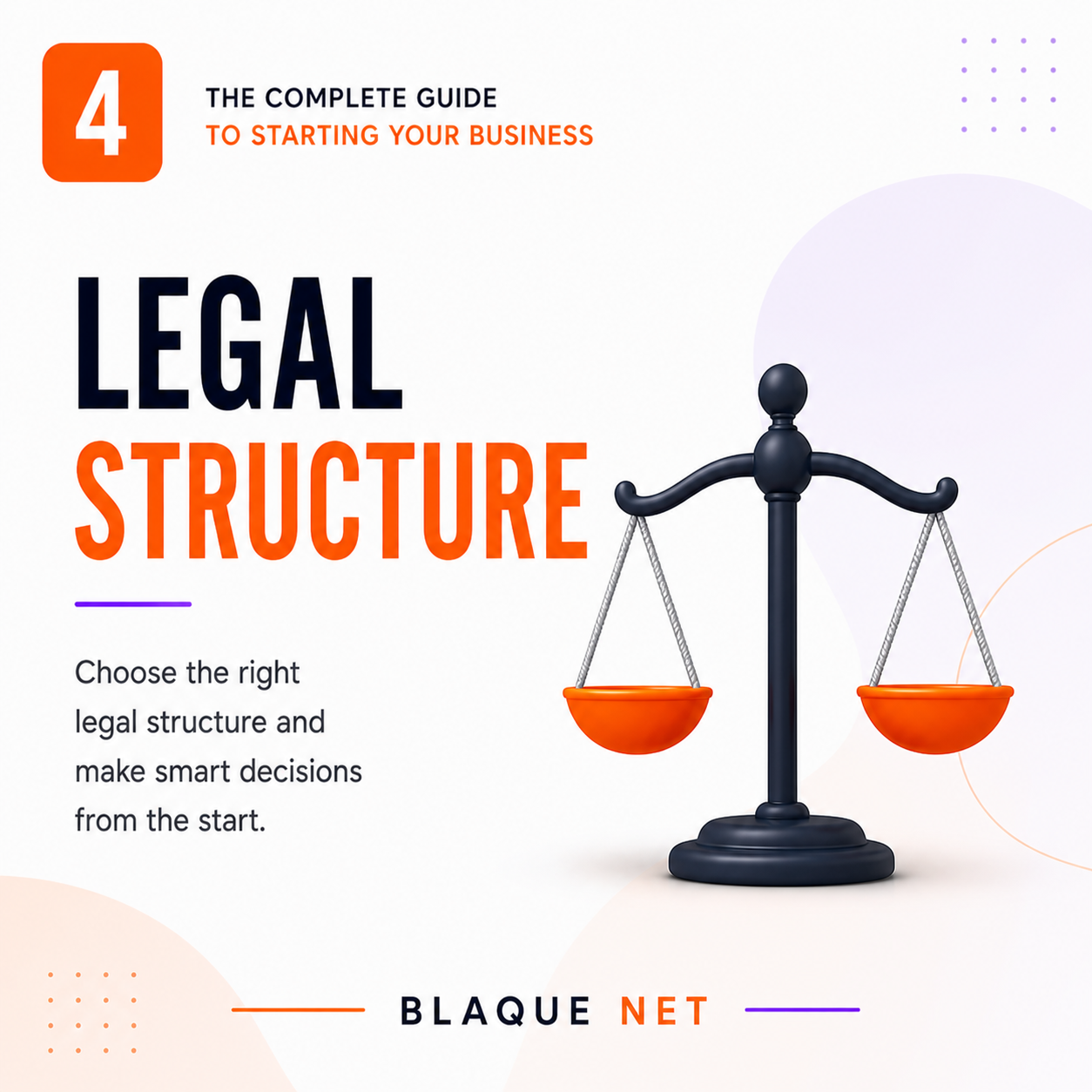
⚖️ Legal Structure & Your First Decisions
⚖️ Legal Structure & Your First Decisions
Your legal structure determines your liability, taxes, and ability to grow. Get this right early — changing it later costs time, money, and headaches.
Why Structure Matters More Than Most Founders Realize
Most people pick a business structure because someone told them to form an LLC, or because it seemed like the simplest option. That can work — but it can also be expensive to fix later when your business grows beyond what that structure supports.
Your structure determines: how much of your personal assets are at risk if the business gets sued, how your profits are taxed, whether you can bring on investors, how you split ownership with co-founders, and what your exit looks like years from now. None of these are small decisions.
The 4 Main Business Structures
Sole Proprietorship
You and the business are legally the same entity. No formal registration required in most states beyond a business license and DBA if using a trade name.
✅ Zero setup cost. Simplest taxes. Total control.
❌ Zero liability protection. Your personal assets (home, car, savings) are exposed if the business is sued or can't pay debts. Not recommended if you have significant personal assets or any risk of liability claims.
LLC (Limited Liability Company)
Separates you from the business legally. The right structure for the vast majority of small businesses and solo founders starting out.
✅ Personal liability protection. Flexible taxation (default pass-through). Easy to manage. Credible. Can elect S-Corp status later for tax savings.
❌ Small annual fees in most states. Some states (California) have high minimum franchise taxes. VC investors generally prefer C-Corps.
S-Corporation
Not a separate structure — it's a tax election you make after forming an LLC or corporation. Profits flow to shareholders but you split income between salary and distributions, reducing self-employment tax.
✅ Significant SE tax savings when profits exceed ~$60K/year. Maintains liability protection. Pass-through taxation.
❌ Requires payroll (including paying yourself a "reasonable salary"). More administrative overhead. Not ideal below $60K profit. Consult a CPA before electing.
C-Corporation
A fully separate legal entity from its owners. Standard structure for companies planning to raise venture capital or issue multiple classes of stock.
✅ Required by most VCs. Can issue unlimited stock classes. No shareholder limits. Best for large-scale fundraising and IPO paths.
❌ Double taxation (corporate profits taxed, then dividends taxed again). More expensive to set up and maintain. Not appropriate for most small businesses.
Side-by-Side Comparison
| Feature | Sole Prop | LLC | S-Corp | C-Corp |
|---|---|---|---|---|
| Personal liability protection | No | Yes | Yes | Yes |
| Ease of setup | Easiest | Easy | Medium | Complex |
| Pass-through taxation | Yes | Yes | Yes | No |
| Self-employment tax savings | No | No | Yes (~$60K+) | Varies |
| Can raise VC investment | No | Limited | No | Yes |
| Recommended for most founders | No | Yes | At $60K+ profit | Startup/VC only |
How to Actually Form Your LLC — Step by Step
- 1 Choose and check your business name — Search your state's Secretary of State database to confirm the name is available. Also check federal trademark database (USPTO) for any conflicts. Your name needs to be available in both.
- 2 Choose your registered agent — Required in every state. This is the person or service that receives official legal documents on behalf of your business. Can be yourself (if you have a physical address in the state), or a registered agent service (~$50–150/year).
- 3 File Articles of Organization — The official document filed with your Secretary of State that creates your LLC. Cost: $50–$500 depending on state. Florida is $125. Delaware is $90. Can be filed online in most states in under 30 minutes.
- 4 Get your EIN from the IRS — Free. Takes 5 minutes at IRS.gov. Required for bank accounts, hiring, business credit, and tax filing. Do this the same day you file your Articles.
- 5 Draft your Operating Agreement — Not required in all states, but absolutely required if you have co-founders. Defines ownership percentages, decision-making authority, what happens if someone wants to leave, how profits are distributed. Even for a single-member LLC, this document establishes your operating rules and protects your liability shield.
- 6 Open your business bank account — Bring your EIN, Articles of Organization, and Operating Agreement. This is what keeps your personal and business finances legally separate — the foundation of your liability protection.
- 7 Register for state and local taxes — Depending on your state and business type, this may include sales tax registration, state income tax registration, and local business licenses.
- 8 Get required licenses and permits — Varies by industry, state, and city. Use the SBA's Business Licenses and Permits tool to identify what applies to your specific business.
Essential Legal Documents for New Businesses
- Operating Agreement — Rules for how the business runs, who owns what, and how decisions are made
- Client Contract / Service Agreement — Scope, payment terms, deliverables, IP ownership, dispute resolution
- NDA (Non-Disclosure Agreement) — Protects confidential information shared with employees, contractors, or partners
- Independent Contractor Agreement — Establishes the freelancer relationship and prevents misclassification issues
- Privacy Policy — Required by law if you collect any user data (email addresses count). Required by ad platforms and payment processors.
- Terms of Service / Terms & Conditions — Sets the rules for using your website or platform. Limits your liability.
- Cookie Policy — Required if you use cookies for analytics, ads, or tracking. Even Google Analytics triggers this requirement in many jurisdictions.
- Refund / Return Policy — Reduces chargebacks and disputes by setting expectations clearly upfront.
Intellectual Property Basics
You may have more IP than you realize — and failing to protect it early can cost you significantly later.
- Trademark: Protects your brand name, logo, and tagline from being used by others. Federal trademark registration costs ~$250–350 per class through USPTO. Highly recommended once your brand has real equity. Before registering, search the USPTO database to confirm your mark is available.
- Copyright: Automatically protects original creative work (writing, code, designs, music, photos) the moment it's created. Registration (~$65) strengthens your ability to sue for damages.
- Trade Secret: Protects confidential business information (processes, formulas, customer lists) that gives you competitive advantage. Maintained through NDAs and internal security — not registration.
- Patent: Protects inventions and novel processes. Expensive ($10K–$50K+) and time-consuming (2–3 years). Only relevant for genuinely novel inventions. Consult a patent attorney before disclosing your invention publicly.
✅ Your Section 4 Checklist
Not just "everyone said LLC" — I understand the liability, tax, and growth implications of my choice.
Name confirmed available. Also checked for federal trademark conflicts at USPTO.gov.
Official legal entity created. Have the filed documents saved securely.
Required for everything: bank account, business credit, hiring, and taxes.
Ownership percentages, decision-making rules, what happens when someone leaves. In writing. Signed.
Federal, state, and local. Industry-specific requirements identified and filed.
Scope, payment terms, deliverables, IP ownership. Never start work without a signed agreement.
Required by law if collecting any user data. Required by payment processors and ad platforms.
USPTO search completed. If significant brand equity is at stake, trademark application filed or in progress.
Especially important if: co-founders, investors, employees, sensitive data, or significant IP.
🎯 Quick-Scan Summary
- LLC is the right choice for most small businesses — liability protection, flexible taxation, easy to manage
- S-Corp election (via your CPA) saves significant self-employment tax once profits exceed ~$60K/year
- C-Corp is only for VC-backed startups or companies planning to issue multiple stock classes
- If you have a co-founder: an operating agreement is non-negotiable before you have assets or revenue to fight about
- Eight steps to form an LLC: name check → registered agent → Articles → EIN → operating agreement → bank account → state taxes → licenses
- Do a USPTO trademark search before investing in your brand — free and takes 10 minutes
- Every client engagement needs a signed contract before work begins — no exceptions
- Privacy Policy and Terms of Service are legally required if you collect any user data (email signups count)
Last Updated: April 2026 · Part 4 of 10 · Blaque Net Start Your Business Series
Questions About Your Business Structure? 🤖
Business Buddy can help you think through the options — then point you to the right professional for your final decision.
Ask Business Buddy →
 Russian
 English
 Arabic
 French
 Spanish
 Portuguese
 Deutsch
 Turkish
 Dutch
Dutch
 Italiano
 Romaian
 Portuguese (Brazil)
 Greek
Greek